These are the steps to drill a borehole in Kenya that we follow as a professional well development company in Kenya
The Pre-Drilling Phase
- Hydrogeological survey. Grekkon Limited conducts a hydrogelopgical survey on site. The company is only commercial outfit in Kenya to adopt the use of Transient Electromagnetic (TEM) solution in the identification of aquifers. TEM has an accuracy level of over 90%. The current hydrogeological survey technology used in Kenya is vertical electrical sounding (VES), in combination with the horizontal electrical profiling (HEP) which are not only old, but have a national average success rate of 60%, which explains the high incidence of ‘dry boreholes’ in the country. TEM also guides on the water salinity levels, and contamination, which is unvailable with VES. In VES, the level of salimity or contamination is only determined after drilling, and a water chemical analysis is done. The final result of a TEM survey is a 3D ground model that is easy to interpret
How TEM works
A 3D ground model generated from TEM survey equipment
The survey is the most importat stage in borehole drilling. This is because, when professionally doen, the farmer optimises the ground water on their site. If poorly conductsed, the risk of dry or poor yielding borehole is high. A site mobility assessment is also done during the survey to determine the suitability of the road in handling the rig, and truck. Where an improvement needs to be done, this is communicated to the client
2. Application and delivery of Water resource management authority (WARMA), and the National environmental management authority (NEMA) permits. These must be in place before drilling commences. Where the county government charges for the process, the client pays the requisite fees to the county authorities directly
3. Generation of a quote
4. Mobilisation. This is the borehole drilling rig’s movement, equipment and labor to the site where the well is to be sunk. The cost of mobilisation varies from place to place, though not significantly, except in areas located >500kms from the nearest company’s branch office
4. Site set up. The team sets up on site in readiness to commence drilling
The Drilling Phase
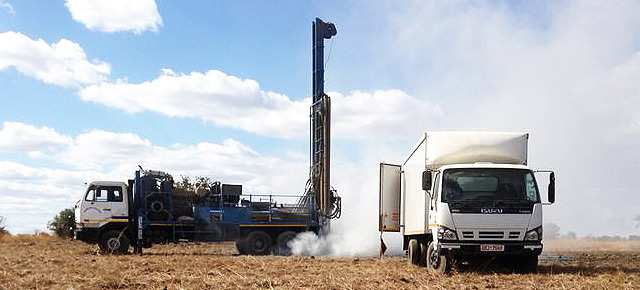
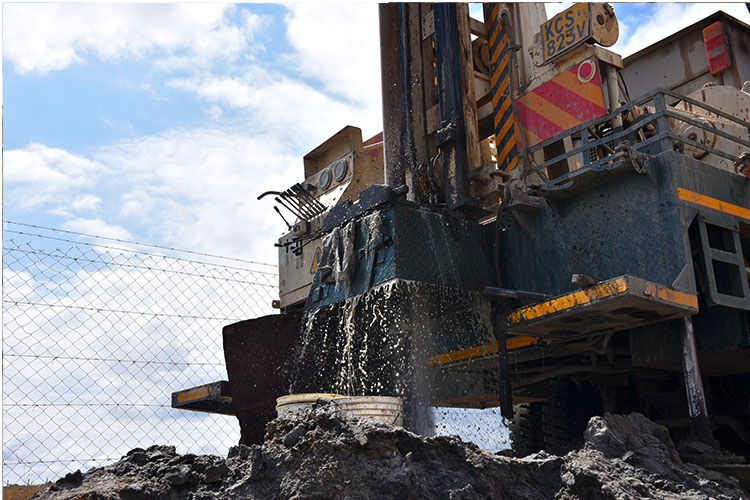
5. Borehole drilling. This is the actual process of sinking a well in the ground in order to obtain water. The depth of sinking depends on the reading of the hydro-geological survey report. This report states the depth, amount of water expected and the geological structure of the soil and rock underneath. The normal size of the borehole is 8 inches in diameter, but the surface section is 10 inches.
There are 2 drilling methods; air drilling, which is for a steady ground formation, particularly well supported by rock. Mud drilling for unsteady ground formation dominated by loose soil or rock.air drilling is the most common one and is cheaper. Mud drilling is predominant at the coast. It is more expensive as it requires a higher level of expertise, and materials
During drilling, every soil profile type sample is collected, marked and shared with clients. This provides them with an understanding of the ground structure, and at what clay or rock profile aquifers were encountered
Steps To Drill A Borehole In Kenya; Post- Drilling Phase
6. Casing. We line the walls of the borehole with mild steel casings, or polyvinyl chloride (PVC) casings to keep the wall from collapsing through out the lifetime of the borehole. The type of casing used depends on the water quality and the depth of the well. For instance, in highly saline wells, PVC casing are recommended as they are less susceptible to corrosion as compared to steel. PVCs are cheaper, and are installed in shallow wells. However, steel casings are stronger, and best for deep wells, unless it is of high salinity, which in this case dense PVC casings are installed. Continuous casings are used all over except where the aquifer(s) is located. Where in this case we use slotted casings to allow for water percolation into the drilled well
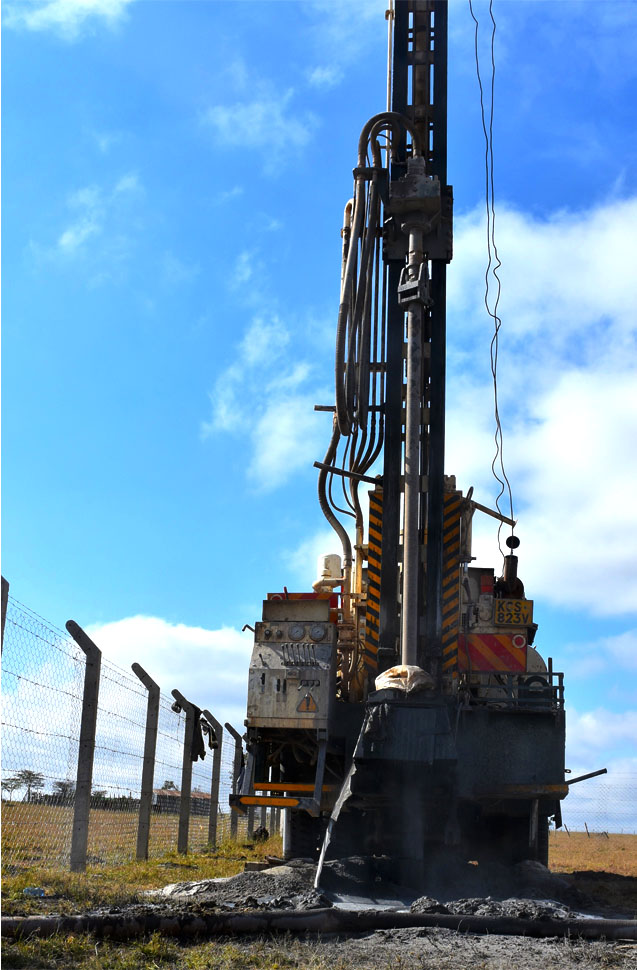
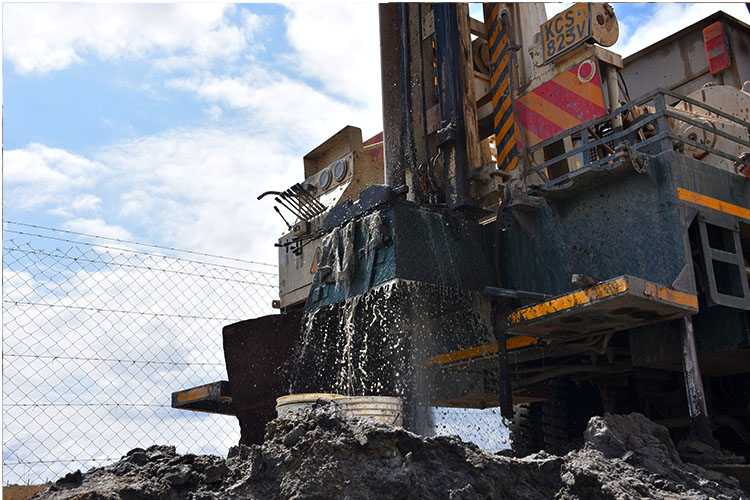
Drilling steel rods on the foreground, and back right of the photograph. These were used to drill the well by Grekkon Limited in Muthuani area, Machakos county
7. Graveling. It is the application of gravel sand between the borehole walls and the mild steel casings. Gravel filters soil and other impurities, and keeps the casings firmly in position
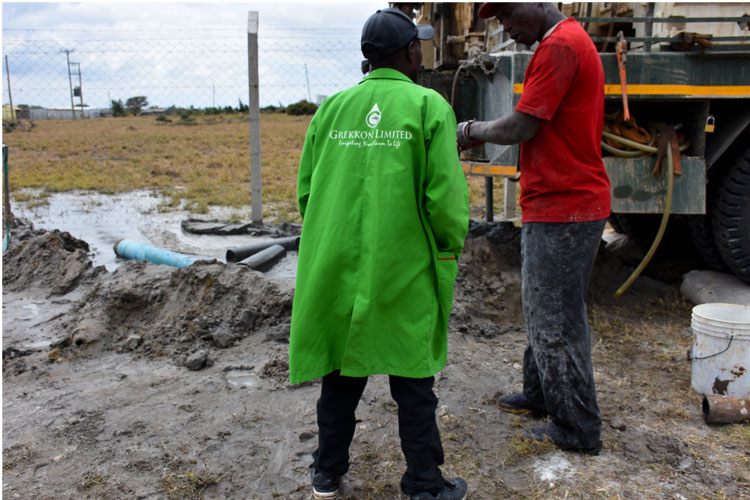
8. Flushing. The well is cleaned of all dirt and impurities to ensure that the water is clean. After this, the well is covered to await the next process
After Well Development
In our steps to drill a borehole in Kenya above, we started off with a survey before drilling. Here, a survey of the well itself is conducted in number 9 below
9. Test pumping. After the above works are done, a seperate smaller equipment is used to
- Determine the water level
- Determine the well’s yield or recharge rate. This is the amount of water the borehole is capable of providing in an hours. It is given as meters cubic per hour. It is through test pumping that we establish the type, and size of submersible water pump to install
View Comments
Total cost of drilling in makuyu, muranga
Good evening Joseph,
Your borehole drilling cost in Makuyu, Muranga is Kes 6,700/M
Best regards,
Customer Service
Approximately how much would it cost to drill a 150 meter borehole in Nyeri.
I want a yield high enough to irrigate about 6 acres
Good morning Wanyeki,
Your borehole drilling cost in Kenya is Kes 975,000 which covers; mobilisation, drilling, casing, gravelling, test-pumping, and water analysis
Best regards,
Customer Service
quotation of 100meter borehole kandara div. muranga county
Good evening James,
Your borehole drilling cost is Kes 670,000 for everything. Please share your contact number.
Best regards,
Customer Service
I need a borehole in Homa Bay. Can you tell me a price for this project?
Thanks
Good evening Okech,
Please share with us your hydrogeological survey report.
Best regards,
Customer Service